
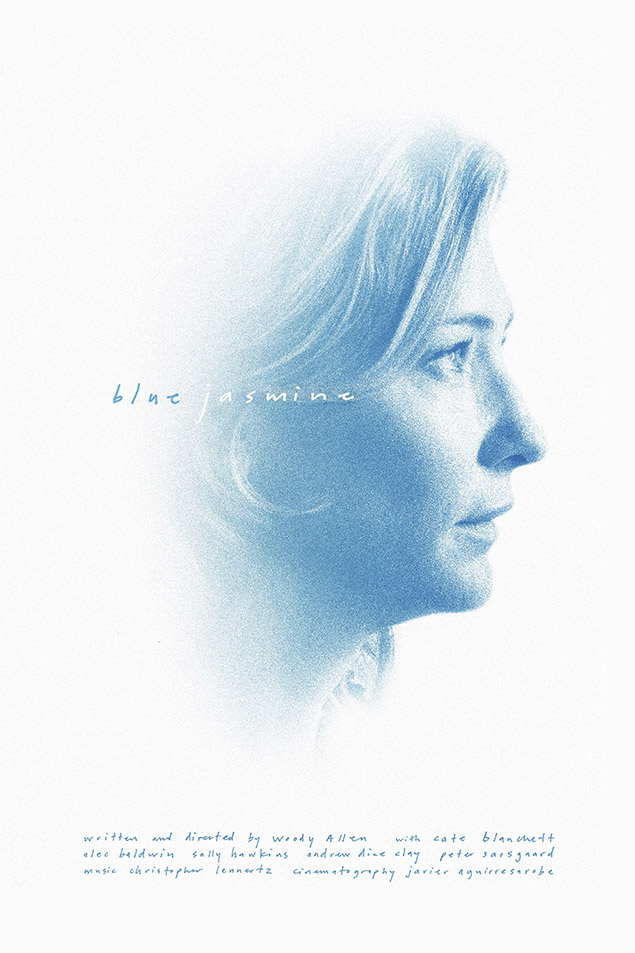
All of the usual suspects are here: cheating cultured elitists who, in an attempt to make their comfortable lives more dynamic, create chaos. Jasmine (Cate Blanchett) is a bird of a different color as her chaos, although self-inflicted to some extent, is uninvited. She loved her husband (Alec Baldwin) and adored her life as a philanthropic trophy wife. When we meet Jasmine, she is on her way to San Francisco talking to a woman about her adoring husband, “when we met Blue Moon was playing.” All the elements of a perfect life seem present. When Jasmine gets to her sister’s Gingers (Salley Hawkins) house things start to unravel.
We learn that Jasmine is “tapped out,” due to her husband’s financial activities while continuing with the mirage of privileged life, she takes first class, and her Louis Viton luggage barely fits into her sister’s living room. In an attempt to put Jasmine at ease Ginger has planned a night out with her boyfriend Chili (Bobby Cannavale) and his friend Eddie (Max Casella). To say Chili and Eddie are not Jasmine’s type is an understatement, with Chili wearing jeans out of an Ed Hardy catalog and Eddie offering her a job at a dentist’s office, Jasmine orders another round.
Still hung over from her privileged life the offer to work as a receptionist for a dentist is insulting, but Jasmine caves as other options seem to have escaped her. In a cloud of booze and self-doubt, Jasmine decides to take an online computer class in order to get her interior design license online rather than the practical approach of establishing connections or working under someone. In terms of real-life Jasmine has no coping skills and tries to hold herself together with Xanax and Vodka. When she meets a well to do attorney (Peter Sarsgaard), the encounter seems too good to be true as lies come more naturally than the truth to Jasmine. It becomes clear that nothing in her previous life, and the one she is currently trying to emulate, gave Jasmine the tools to understand who she is in the world.
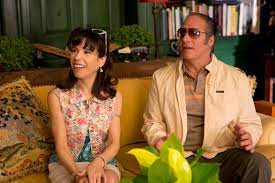
By talking to herself on street corners, park benches and airplanes perhaps she is trying to unravel her life? The film taps into the idea that there is the life we have always dreamed of and the life we get, Jasmines predicament is that she tasted the dream. Blanchett is superb as both the broken and superior Jasmine, with her milky skin and ethereal good looks; she resembles a porcelain doll who could shatter at any moment. With stellar performances by the always enchanting Bobby Cannavale (whose star became a bit brighter after his performance in “Boardwalk Empire”), Sally Hawkins, and Andrew Dice Clay, the Woody Allen / Juliet Taylor combination continues to be on the pulse of collecting superior talent. The fact that Taylor and Allen took a chance on Dice exemplifies why their films are still relevant and as the comedian presides over each scene the way he did onstage, Dice is a giant among men.
The only real tragedy is that the audience never gets to meet the real Jasmine. Yet to bring Jasmine full circle is not the type of ending Allen is interested in. He was the schmuck at the coffee shop in “Annie Hall” watching Diane Keaton walk away and has no interest in alleviating the audience of its fears. Aside from its dark subject matter “Blue Jasmine” has the type of comedic moments only Allen could produce. When Jasmine confesses that she would like to go back to school to be an anthropologist, Chili responds with, “like digging up bones and stuff?” Regardless of the correct definition, it is clear that Jasmine is far more ridiculous than her philistine counterparts. The idea of becoming an anthropologist is so absurd that she might as well start digging up bones. Chili, with his slicked back hair and tight jeans is the voice of reason.
It should be noted that this is one of the first times, aside from films dedicated to his childhood, that Allen has explored the working class. With an aptitude for struggle, hard work and perspective (which is something that the elite has no patience for) we see how much is missing in the way of judgment. “Blue Jasmine” is the type of film Woody Allen makes every 4-7 years, where his humor and take on tragedy is right on point.
 FILM SQUAD