
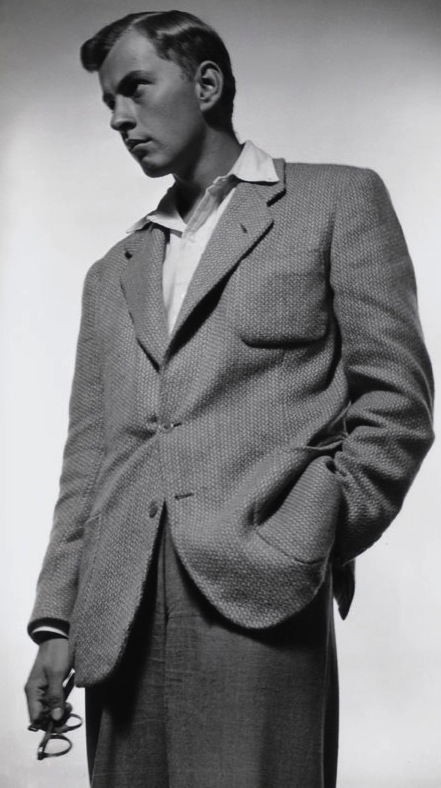
“It was very clear, you don’t decide to be a writer you are one, or you’re not one. Art is not a democracy.”
In the film “Gore Vidal: The United States of Amnesia” filmmaker Nicholas Wrathall captures Vidal at several stages of his life, opening the film with Vidal at a graveyard in St. Paul’s Church cemetery in Washington DC as he name-drops who is buried there while standing near a plot, he has reserved for himself. A fitting introduction to a man who views life and its transgressions as a blunder, “whenever I want to know what the United States is up to, I look into my own black heart.”
A man who finds contempt in everything the same way his mother had contempt for him is asked, “if you could change anything about your life what would it be?” To which Vidal responds, “my mother.”
A perfect epitaph for a writer, unloved, unwanted and raised by his blind/Senator grandfather Thomas Pryor Gore who chose law school over institutionalization. The concept of not being able to see letters on a page was of no consequence, Thomas Gore would simply bring his cousin along to read to him. His young grandson Eugene (who later changed his first name to Gore in honor of his grandfather) would be his aid in the Senate. Senator Gore hated most people but loved Vidal. This contempt carried on through his grandson’s worldview, which was further emphasized by the death of Vidal’s first and only love, a boarding school friend Jimmie Trimble, who died in the Battle of Iwo Jima. When prompted by a journalist about “a great love affair” Vidal’s response is telling:
One was really enough, I don’t think it happens twice . . . there are some people who I think are partial to the notion, particularly kids, of having a twin and all that I was not he was, and all that he was not I was, and the two of us would have been pretty good had we been rolled into one.
When asked as a much older man about the love affair Vidal shrugs off the romance, “well that was schoolboy stuff. That’s long long long ago.”
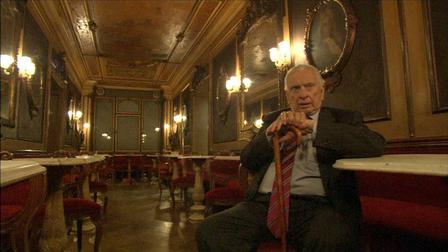
In his later years Gore would praise promiscuity and condemn love:
Certainly, I am devoted to promiscuity and always have been, I believe the more you do the better it is for you I am a great health nut. I don’t like the word love, it’s like patriotism, it’s like a flag, it’s the last refuge of scoundrels when people start talking about what warm deep emotions they have and they are loving people I watch out, somebody is going to steal something.
Vidal’s language often has a cunning effect as if he knows everything because he hates everything. The boyhood crush cuts through the condescension as if Vidal’s words represent the same frauds he is pontificating against. Yet this angry and motherless boy finds a perfect home on a typewriter and as the subject of this film. Vidal’s childhood is primed for the life of a writer and we learn that his father (who had an affair with Amelia Airheart) flew planes which Vidal tested at the tender age of ten, proposing the idea that if a child can fly anyone can. Vidal was destined for a life of greatness, bordering on farce.
Wrathall documents this with an array of stock footage, which is complimented by his access to the writer, following him around Italy, D.C., Los Angeles and wherever his cane shall roam. Age doesn’t stop Vidal’s wandering life, but unfortunately the reality of an aged body does. Wrathall’s camera captures Vidal as he packs up his home in Italy after Howard Austin, his partner of over 50 years, dies. Vidal is now unable to walk the long winding terrain of his sprawling Italian estate and must move to Los Angeles to be closer to family.
It’s hard to cover a man of many occupations and Warthall accomplishes this task by concentrating on Vidal’s verbal essence. Vidal’s quotes are aligned through the film like chapters—the Reagan years referred to as a man who is good at reading cue cards and Camelot as a fraud— “No action ever followed any speech. The thing about myths and legends: should we allow reality to intrude? The Kennedy legend is a very good one for the world and it’s a very good one for the United States. As a critic I am sort of split. On the one hand I know it’s not true, and on the other hand I think if it’s not true it ought to be true.”
One of the most hysterical scenes in the film occurs when Vidal rolls his eyes as Obama makes his acceptance speech in Chicago after winning the presidency in 2008. “I would like to think of him as completely virtuous, I suspect he is not. Why do I suspect that? Because I know how politics works.” With his grumpy old man condescension, one wonders if Vidal is someone of great insight or arrogance? Despite the political or cultural stance of its subject, the film is strong as Vidal’s life is truly remarkable and dynamic.
As the film shows fear was not really a concept for Vidal, merely a stepping stone for the next adventure, traveling through Europe with Tennessee Williams, writing a critically acclaimed best seller at nineteen and (after being shunned by the literary community due to homosexual leanings) Hollywood, like working at Jamba Juice after school in the mall—became his financial safety net.
The point of the film is not to agree with Vidal’s politics or disdainful view of America, but to follow a boy who decided that being an adult was for fools. Vidal never surrendered to what many would mock as childhood shenanigans: running for president, getting into shouting matches with William F. Buckley Jr. and living off of a bluff overlooking the coast of southern Italy—perhaps peculiar choices—yet the driving force behind his audacity.
The film is now streaming on Netflix
 FILM SQUAD