
By Michelle Montgomery
“When my father passed, I wanted nothing more than my mother’s happiness. For what kind of a man would I be if I did not help my mother. If I did not save her. . . ”
-Peter Gordon
Peter Gordon (Kodi Smit-McPhee) is a critical observer who continues to find creative ways to fill his days, be it at his mother’s modest Inn or at the Montana ranch where he now finds himself. Peter creates scrapbooks from the beautiful images he sees in magazines, makes paper flowers for the centerpiece of his mothers dining room, traps animals he wishes to dissect and only engages in conversations when he wishes to gain knowledge. One afternoon while riding with Phil Burbank (Benedict Cumberbatch) Peter catches a rabbit. Phil attempts to catch the rabbit in his arduous and rough nature, while Peter successfully catches the rabbit effortlessly by whispering to it and gracefully taking the rabbit into his arms. As Peter notices the rabbit’s broken leg he pets it and whispers “it’s all right” then breaks its neck in an effort to kill the rabbit without pain, to do no harm.
Peter is studying to be a doctor and therefore understands the nature of men perhaps more than others. His analytical sensibilities lend to him the incredible ability to only take on tasks and conversations that add to his intellectual prowess. When Peter finds himself at a cattle ranch in Montana after his mother Rose (Kirsten Dunst) marries one of the owners, George Burbank (Jesse Plemons), he does so with the knowledge and foresight that not all is well. Peter is aware of Phil who refers to his brother George as “fatso” and parades around the ranch as not only one of its owners, but it’s master. Phil, a graduate of Yale who studied “the classics”, has mastered just about everything: ranching, riding, roping, playing the banjo, conversation and castrating.
Jane Campion (who directs the film) gives us slices of Phil and slices of each character’s life in order to give the film an interpretive element that has been lost from filmmaking in recent years due to oversaturated storytelling which “binge worthy” series can often provide. Campion whose acclaimed series “Top of the Lake” (2013) allowed her to explore television, has not made a feature film since “Bright Star” (2009) and with “The Power of the Dog” she has made her most captivating film since “An Angel at my Table” (1990). Campion has a way of looking at ordinary people and ordinary experiences as they shape into something extraordinary which she did with the complex and harrowing life of New Zealand writer Janet Frame in the 1990 film.
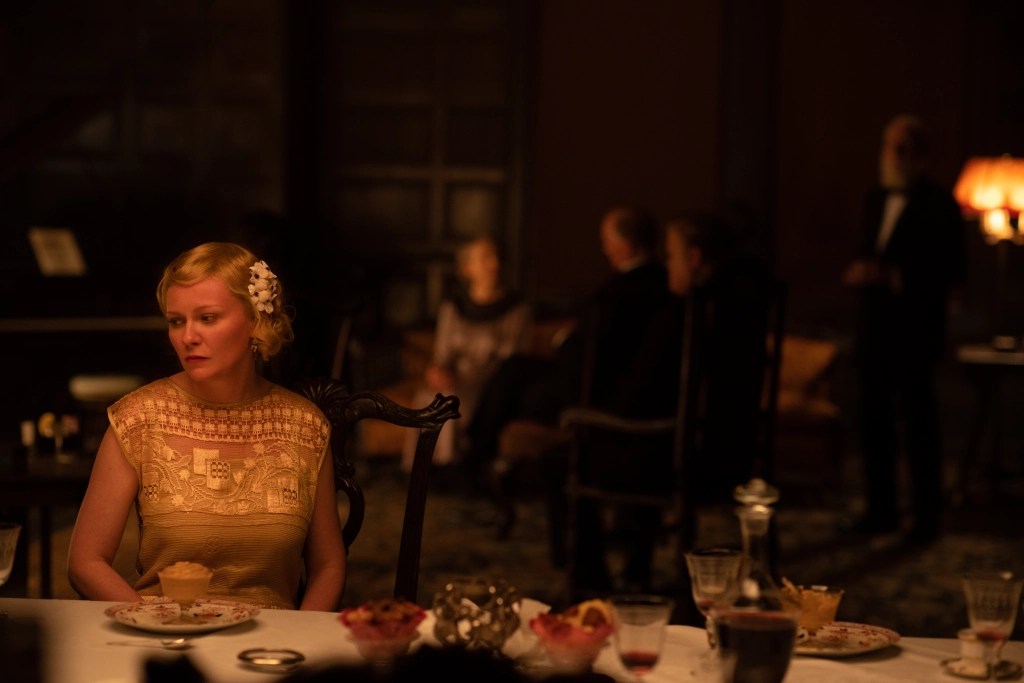
Unlike the novel, written by Thomas Savage, Campion leaves certain details out in order to create her own brand of visual storytelling. The setting of each scene (particularly those between Peter and Phil) tell their own story for those who are willing and able to see it. Initially Phil has little regard for Peter (at least outwardly) as he stumbles onto the ranch in white sneakers, white socks, wide-legged jeans which he fails to fill out and a large oversized cowboy hat. Peter, unlike Phil, does not look the part but that does not mean he is not willing to learn how to play it.
During one of the few whimsical moments in the film, Peter, Rose and George come upon a campsite where Phil and the other cowboy hands have pitched tents and made grub. As Peter makes his way across the campsite to look at two blue jays flying into their nest, the cowboys begin to whistle at him and mutter “little faggot . . . little Nancy.” The only eye contact Peter makes is with the birds as he walks closer to the tree; it’s as if he’s alone in the forest and the words have no power over him. Phil recognizes Peter’s confident scrutiny and calls out to him, promising to make him a rope before he leaves for school. From this point on the audience isn’t sure how to perceive this new “friendship” and do so with caution as Rose observes the pair.
As the story unfolds it becomes clear that these two men have more in common than what meets the eye. Phil, like Peter, is interested in knowledge and hobbies which serve as they challenge him and Peter knows this. Both Peter and Phil are aware of the power they hold over other people and choose to use this power in separate ways. Phil berates, tirades and attempts to deduce people to their lowest form as he does with Rose. Peter is soft-spoken in his brilliance and has a strong purpose behind what he does, Peter’s purpose does not involve brutally crushing those he detests, but learning from them.
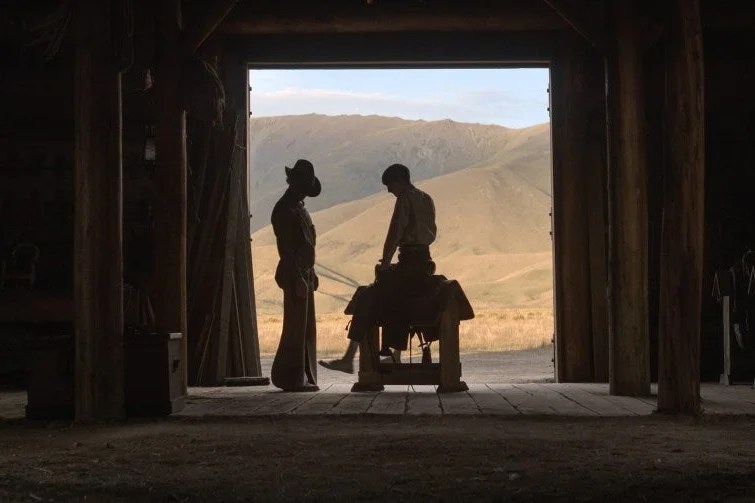
Phil (Benedict Cumberbatch) teaching Peter (Kodi Smith-McPhee) to ride
Campion’s powerful character study takes place in 1925 just 36 years after Montana became a state and 65 years after congress passed the Indian Appropriations Act, which provided funds to move Indian tribes to farming reservations. The Ford Model T (in which George drives) is likely the only model T for 50 miles and the defining characteristics of male roles is beginning to “change with the times.” Campion’s film resonates due to its abundance of storytelling and her ability to understand how the times shape the characters: Phil does not allow the Indians to buy his hides (he prefers to burn them) and if a person subjects themselves to driving a car well then they must be a “Jew.” Through its cinematography (the film was shot by Ari Wegner who is known for “Lady Macbeth” and Soderberg’s “The Girlfriend Experience”), understated acting and jarring score, Campion creates a sensory experience. Each artistic element has its own story to tell, particularly the score, which was composed by Radiohead’s Jonny Greenwood whose scores for “There Will Be Blood” and “The Master” added to the scope and intention of each scene. With “The Power of the Dog” Greenwood’s score has a beautiful randomness to it, giving each character and scene it’s own individual richness.
The film’s awe resides in its ability to bring forth the subtle aspect of human nature and how we the audience choose to perceive each removal of the curtain. Although Campion definitely has intention behind what she does, she does so with little ego, allowing the audience to view the film through personal perception, which is the most powerful way to see a film. Campion uses the novel beautifully as a backdrop, but not as a centerpiece. Very little is said or done until Campion ends the film and like life nothing amazing happens until it does.
An additional piece to the film is the acting as no sole proprietor “steals the scene.” The four main characters: Peter, Phil, Rose and George all carry with them a weight that resonates and pulls us in. Smit-McPhee, Cumberbatch and Dunst have all received well deserved Golden Globe nominations (which were announced by Snoop Dog on December 13th who managed to mispronounce Ben Affleck’s name). Jesse Plemons (who shares two children with Dunst) has done well with an under the radar, but celebrated career. Smit-McPhee and Cumberbatch are given more to work with and do a remarkable job understanding the intentions of their characters. Smit-McPhee (who was 24 when the film was made) gives a standout performance as Peter considering the subject matter and how he was able to delicately make each scene work.
The film works because it resonates and gets to the marrow of why we hurt and extinguish with or without harm. Thomas Savage who wrote “The Power of the Dog” grew up on a Montana cattle ranch and would describe his time on the ranch as lonely and feeling out of place. Savage would go on to have relationships with men while he was married and likely met archetypes like Phil: the intellectual and sharp tongued ranch owner who was free to do anything, scoffed at “society” and all of its trappings, only to harbor a deep resentment that change would not be taking him with it.
 FILM SQUAD