
The controversial documentary premieres at the Sundance Film Festival
By Michelle Montgomery

Towards the end of the film “Charlie Wilson’s War,” which chronicles the senators (Tom Hanks) role in aiding Afghanistan with weapons against the Russians during The Soviet-Afghan War (1979-89), CIA agent Gust Avrakotos (Phillip Seymour Hoffman) shares an insightful parable:
There’s a little boy and on his 14th birthday he gets a horse… and everybody in the village says, “how wonderful. The boy got a horse” And the Zen master says, “we’ll see.” Two years later, the boy falls off the horse, breaks his leg, and everyone in the village says, “How terrible.” And the Zen master says, “We’ll see.” Then, a war breaks out and all the young men have to go off and fight… except the boy can’t cause his legs all messed up. and everybody in the village says, “How wonderful.”
Afghanistan would go on to utilize the over 300 million dollars in aid from the Pentagon[1] which served as an impetus for the Taliban and al-Qaeda. The parable reminds us that even when the intention is to “save” a vulnerable nation, ignoring the origin of this vulnerability can be its undoing. “Jihad Rehab,” which premiered this week at the Sundance Film Festival, begins with Khalid (a graduate of the rehab center) informing the filmmaker, Meg Smaker, that “in every story there is bad and there is good but it’s a thin line.” Khalid then tells Meg that when he first joined an al-Qaeda training camp there was a list of 200 names ready to take their life “to change the world.”
In her intro Meg reminds us of America’s role in the Soviet-Afghan War and how the United States supplied weapons and training to the region. We also learn that after al-Qaeda returned to Saudi Arabia, the country would “experience more terrorist attacks from 2003 to 2005 than any other country in the world” and in response its government formed a rehabilitation program for individuals deemed terrorists.
Rehabilitation is tricky business as several factors must align in order for the mind and the body to feel safe and productive. Rehab centers typically make this attempt by offering a variety of services which target cognitive functioning and decision-making skills, financial planning, relationship building and individual and group therapy sessions which target negative thinking patterns. There is also a focus on integrating back into society as a productive member which is obviously more pronounced with this type of rehabilitation as these men have been locked away at Guantanamo Bay for close to 20 years.
It is important to point out that when an individual is sent to Guantanamo Bay they are not tried in a court of law. According to the ACLU the “original intention” of Guantanamo Bay was “intended to be an ‘island outside the law’ where terrorism suspects could be detained without process and interrogated without restraint.” During the Q&A session after the film, the filmmakers informed its zoom audience at The Sundance Film Festival that 39 people remain at the prison, all without a trail or a charge. [2] This has powerful implications for the rule of law as it completely disregards due process. When due process is disregarded, the rules of nature which bind us as humans begin to falter and we lose trust in each other.
“Jihad Rehab” never really goes into what these men did in exact terms and only a small portion of their rap sheet is shown as they are being introduced to the viewer. This was likely done in an attempt to see these men as human beings as opposed to “evil doers” or “terrorists.” This is also an aspect of treatment, the why behind the behavior can never really be solidified if the men and the people who treat them only focus on their crime. The focus needs to be directed towards what aspects of their lives led them to the training camps in the first place.
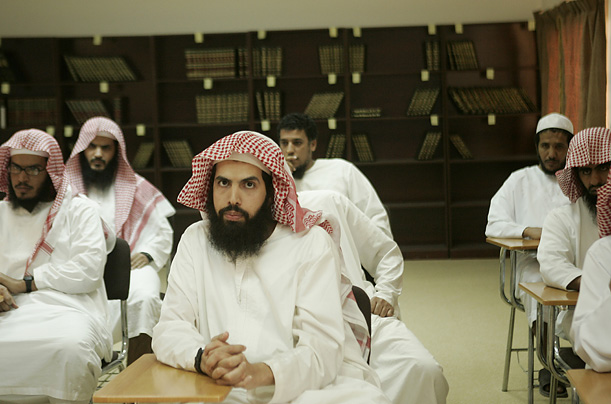
As Meg pointed out in the Sundance Q&A only four men from the facility were willing to speak with her as she felt it would be more authentic to show their faces (which is already causing controversy for the film), with one of the men, Abu Ghanim (who according to U.S. documents was one of the bodyguards for Osama Bin Laden) deciding to drop out mid-way through filming. Initially Abu makes for one of the most interesting subjects as he mindfully shares only certain aspects of his life, including that he first joined rebel forces in Bosnia during the war of liberation as a reaction to the decimation of communities, ethnic cleansing and mass rapes, most of which was directed towards Muslims. At one point Abu is watching Trump on T.V. (who is visiting Saudi Arabia in order to negotiate an arms deal) and refers to him as an idiot and tells the camera that he hopes Trumps kids are smarter.
We also meet Mohammed, Ali and Nadir who were all Yemen detainees at Guantanamo Bay selected to take part in the “Mohammed bin Nayef Counseling and Care Center” a 12-step rehabilitation program that includes counseling, art therapy, recreation and lessons on what “Jihad” really means. There is an Olympic sized swimming pool, and its inhabitants drive around on golf carts in between groups on the conscious and unconscious mind. Men dressed in white thobes discuss Freud’s “ego, super ego, and id.” We also meet Sheikh Ahmed Hamid Jelan from the Ministry of Islamic Affairs who leads Koranic studies which include discussions about the interpretation of Islam.
Jihad in its most literal sense means “striving” for or “struggling” for something, essentially faith with a purpose. In Islamic law (sharia) the term refers to a struggle against non-believers.[3] In its most modern alliteration Jihad has been equated to warfare. What the instructors at the center strive to do is to take the literal warfare out of Jihad and bring it back to its faith-based connotation. But as Abu points out “I don’t believe them” and it becomes clear that Abu sees this form of teaching as indoctrination. The film points out there have been cases of recidivism where known associates of al-Qaeda have returned and were able to “fake” their way through the program. The filmmaker makes one thing very clear, just like any other rehab facility, there are no guarantees, and an immense amount of support is needed post-graduation in order for the men to be successful.
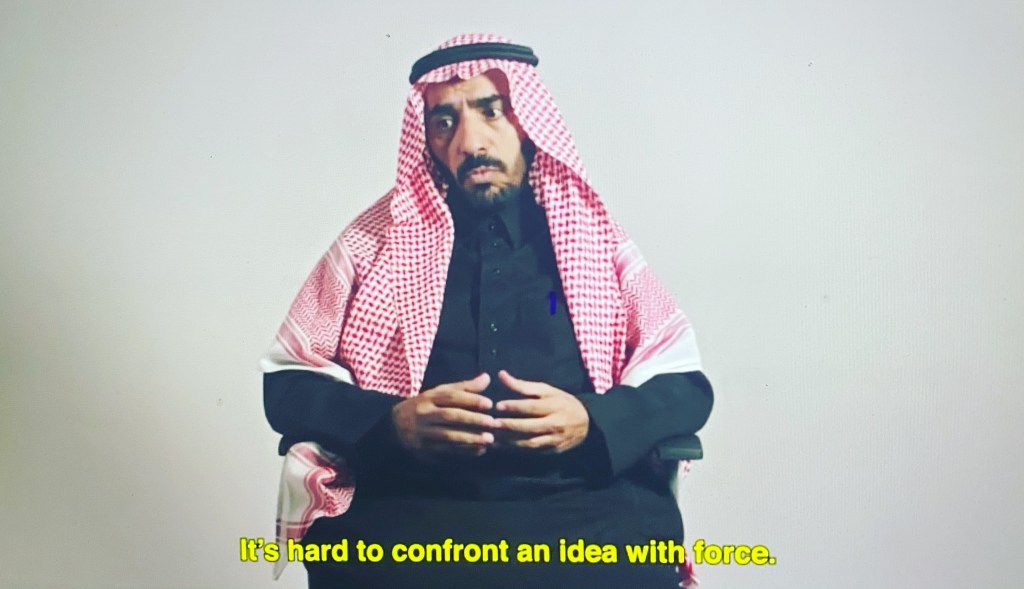
With Mohammed, Ali, Nadir and even Abu there is nothing fake about them which gives the film the strength it needs to overcompensate for other barriers. The men are quaint in their ability to tell the truth because that’s all they have left. Ali, who is the brother of Qasim al-Raymi, the former leader (prior to his death) of al-Qaeda in Yemen who was connected to the July 2007 suicide bombing that killed eight Spanish tourists, strives to create a new life for himself, separate of his brother. Ali states “I love my brother, and I hate what he did to me.” Ali was 16 years-old when he was taken to Guantanamo, and he recalls that during his first weeks at the center he continued to perform his daily tasks with his wrists connected to each other (as if he were still in handcuffs) and admits attempting suicide while at the detention camp. Ali recalls that he was detained for his knowledge, not his crimes as the U.S. wanted information about his brother which initially, he did not give.
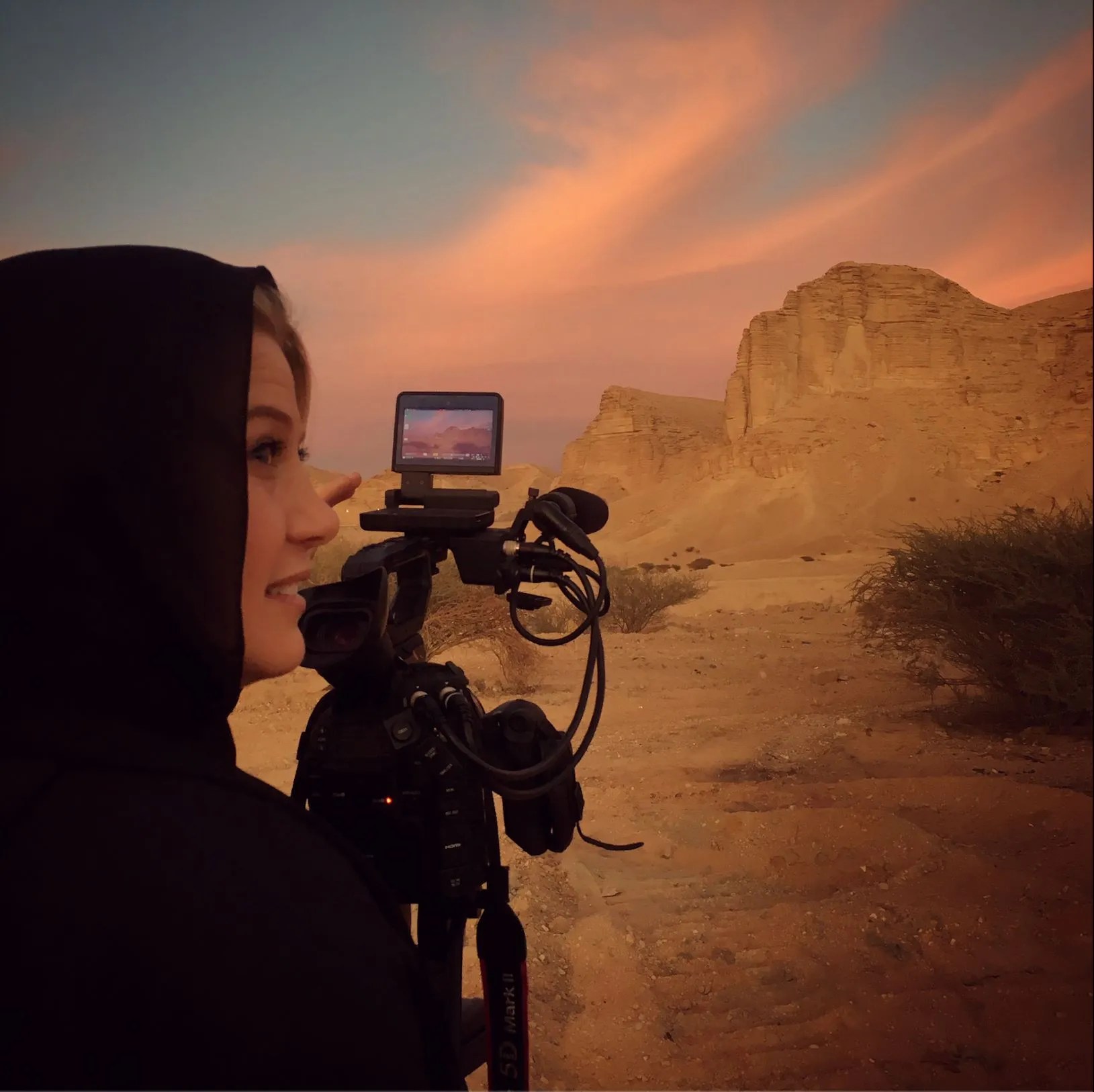
Which brings us to the question of safety for this film as the men’s faces and names are used. “Jihad Rehab” was directed by the young and white American female, Meg Smaker, who was working in Yemen as a fire instructor prior to becoming a filmmaker. Meg worked for over a year to get access to the rehab center and one of the questions during the Sundance Q&A was: is Meg the correct person to make the film? Which she goes on to state that having grown up in a conservative household “who voted for Trump twice” and being a woman who had lived in the middle east for several years, gave her a certain perspective that she felt was relevant to audiences. It is true that the men have a certain chemistry with Meg and she herself becomes a character in the film which at times becomes problematic.
We see Meg by the pool dressed in an abayat, in a car asking Mohammad why she can’t film whilst he is driving up to a known drug dealer and pressing the staff as she asks why their teaching methods have changed since the regime change. Although it may be true that Meg’s focus is not ideal, the story of the three men is needed (ideally in a different context) but this is where we are. Like with the U.S. military rebel fighters do not view themselves as terrorists, they view themselves a fighters for a cause. Men in America go off and fight and so do we.
Nadir, Mohamed and Ali all speak of a purpose or a lack their of which drew them to the fighting camps of al- Qaeda. These were opportunities with money which created a sense of family, faith and accomplishment. The Center aims to re-create these aspects by giving the men brotherhood where they pray together five times a day, fast together and plan for a better life together. As the men near graduation, they meet with Khalid (who now makes car alarms instead of bombs) who informs them that they need to stay busy and have a job in order to succeed. Getting a job and a wife is now at the center of their minds with Nadir asking how appropriate it is for him (a man in his 40s) to take a young bride? To which he is told by his instructor, “woman mature faster than men.”
When Mohammed bin Nayef (who created the center) is removed from office by royal decree and replaced by Mohammed bin Salman, the men’s graduation is stalled for one year and they begin to lose hope. Mohammed equates this to the story of the worm:
It’s like the story of the worm. The worm who was taken care of even though it was in the middle of the dessert. So one of the profits who saw it prayed to God and said “let me be the caretaker of that worm.” Then he forgot about it. So the worm prayed to God and said, “You’ve put my destiny in the hands of a human. Put my life back in your care.” God doesn’t forget us.
The men eventually get released but are not allowed to leave Saudi Arabia and, as non-citizens under the new regime, are not able to get jobs in the country. Mohammed and Ali get married and have children, but they are unable to provide for them which as any man can attest (particularly men in this region of the world) is a death sentence.
The film has been receiving a great deal of backlash on the Twitter, mainly due to how the film frames the men, as terrorists, although they were never tried or charged as such. The filmmaker however does ask her subjects what they think of this word and asks “are you a good person or a bad person?” To which Mohammed replies, “That’s your job to figure out,” recognizing her power as a filmmaker to show the world who he really is.
[1] Crile, Charlie Wilson’s War 409-13
[2] ACLU, Guantanamo Bay (https://www.aclu.org/issues/national-security/detention/guantanamo-bay-detention-camp)
[3] Peters, Rudolph; Cook, David (2014) “Jihad” The Oxford Encyclopedia of Islam and Politics. Oxford: Oxford University Press.
 FILM SQUAD