

Mike White’s Season Two of “The White Lotus” deals in love triangles of power and beauty, setting the stage for the modern female protagonist
By Michelle Montgomery
Haley Lu Richardson (the actress who plays Portia in season two of “The White Lotus”) when discussing the show to press, asserted that in order to be a protagonist in your own story, you inevitably become a villain in someone else’s. This idea brings forth the question of self-preservation and causes one to examine motivation as it relates to self interest. Do we stay in a stale spot, a bad job or relationship in order to avoid harming others, or do we elevate ourselves to the shelf we desire? As Psychologists have been pointing out for years, sociopaths are captains of industry not necessarily because they yelled louder or fought harder (quite the opposite) and as James Fallon points out in his book “The Psychopath Inside” the main driving force is a quiet chess game of self-interest. If we don’t make too much noise no one can catch us.
The protection of one’s own interests seems paramount in maestro Mike White’s second undoing of privilege and status in season two of “The White Lotus.” White has described the second season as a “bedroom farce with teeth,” yet what he gives us surpasses farce as it lavishly unravels the roles of love, beauty, power and control (essentially seduction) and how each aspect interplays within intimate partner relationships.
When we meet the cast for the first time as they arrive on boat to the Sicilian coast of Taormina each character seems wet with a mild unease as they venture away from their own particular normal. Jennifer Coolidge (yet again) plays the befuddled Tanya pouting and cooing her many needs to the crew alongside her aptly named (and chronically unsatisfied) assistant Portia. We also meet two distinctly different couples traveling together: Harper (Aubrey Plaza) & Ethan (Will Sharpe) and Daphne (Meghan Fahy) & Cameron (Theo James). Along for the ride is Dominic (Michael Imperioli) traveling with his son Albi (Adam DiMarco) and father Bert (F. Murray Abraham) whose “cute” and idealized family vacation turns out to be nothing of the sort.
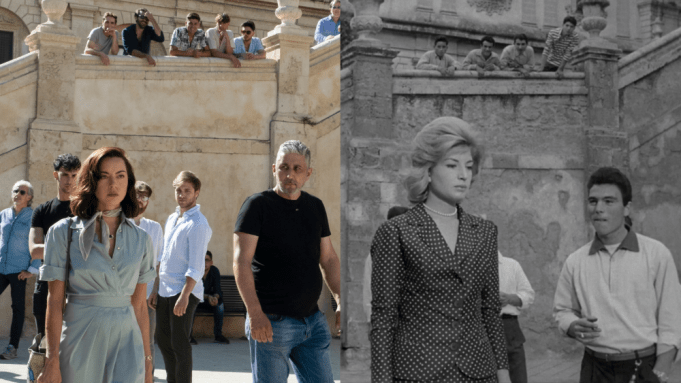
Harper / Claudia
In season two’s location the Ionian Sea (which is bounded by southern Italy) seems murkier and slightly more terrifying as it weaves and crashes through the rocks just as it did in Michelangelo Antonioni’s “L’avventura.” Antonioni’s 1960 film of betrayal and seduction on the Mediterranean (which “Lotus” is loosely-loosely based and shares several filming locations) follows Sandro (Gabriele Ferzetti) and Claudia (Monica Vitti) as they search for Sandro’s missing girlfriend Anna. In the midst of searching Sandro seduces Claudia, a headstrong and savvy blonde who withers into a lovesick child at the films end. As White’s opening credits suggest we are in the midst of the ultimate seduction, only the woman in his tale don’t turn into lovesick children.
The men in White’s tale tend to be buffoon-ed by their own self-interest. Such is the case of Bert, a one-time philanderer (now in his 80s) who has no issue discussing his hard “Achilles cock” to his grandson Albi. When Bert and his family visit the ancient ruins of a Roman Amphitheater near their Hotel, Bert makes a case for cheating by describing the myth of Hades and Persephone:
“Hades raped Persephone right here in Sicily. She was picking flowers and he burst through the earth and raped her. Well, that’s what happened, he raped her. Then he dragged her down to the underworld. Demeter forgave Hades and he raped her daughter. I mean, whatever you’ve done can’t be as bad as that. As Hades, and the raping.”
Bert, a man who regularly cheated on his own wife, badgers his son Dominic throughout the vacation for being too messy and having less discretion than his old man. Bert is a representation of the old patriarchy which has long past, or so his grandson Albi tells him. White has created a tapestry of characters who are all in turmoil with their status and their partnerships and has selectively chosen cheating as the main device in which to showcase each character’s collapse into themselves.
Vacations often start out like romance– tasting new foods, wine and walking down quaint cobblestone streets– with the seduction typically lasting as long as your first hangover in a stranger’s bed. When Tanya’s husband Greg (Jon Gries) leaves Sicily for “work,” suddenly no one is on vacation anymore. As the series unfolds Tanya finds herself escorted to the Palermo Opera House for a presentation of Puccini’s “Madam Butterfly,” the story of a 15 year-old Japanese girl who is seduced and wed by a young American Naval Officer who leaves her after he finds a “proper” American wife. As Tanya arrives at the opera house with four dazzling, vivacious and glamorous gay men she waves to the queen of Sicily and holds hands with her new bestie Quentin (Tom Hollander) as they both cry for the devastated Butterfly.
Once Tanya and Quentin settle back home to his exquisite and ornate palazzo they discuss love and beauty like one would describe the elements of fire and ice. As Quentin affirms while quoting Gore Vidal “love has never been my Achilles heel. It was always beauty [. . .] I’d also die for beauty, wouldn’t you?” It’s not until Quentin and Tanya toast to beauty that we realize the cost, as love (trust, companionship, communication) can often be diluted by beauty (sex, lust, obsession).
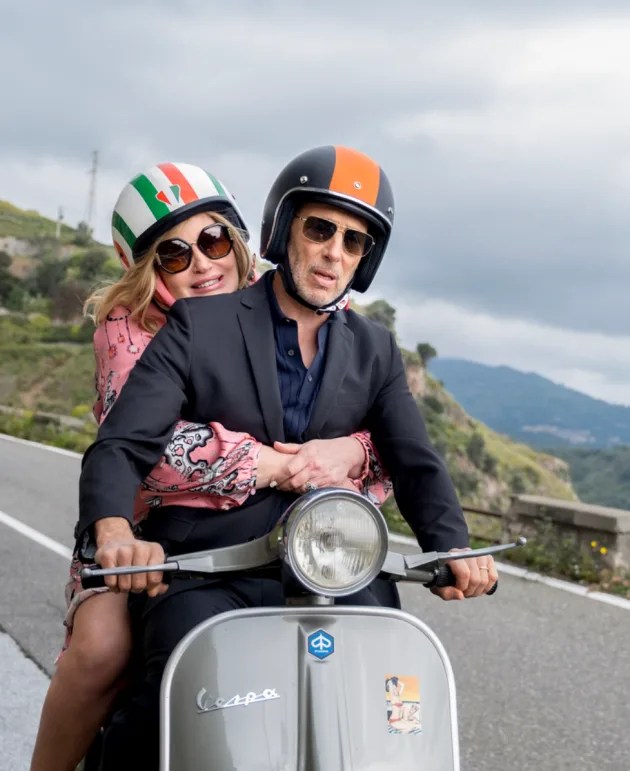
Tanya holding on to Greg for dear life
As the Sicilian episodic melodrama continues beauty becomes the main culprit for White’s cast as they lose focus amongst the temptation and stunning scenery. White later reveals that both Tanya and Quentin love the same man (and perhaps) have both been scorned by him at separate times in their life, attempting to reclaim what they feel is rightfully theirs. For Quentin maintaining his palazzo (sans tourists with Tanya’s money) and his relationship with Greg are of prime importance. Tanya is aware of her obsession with beauty but not much else, leaving her to “end up in a lot of strange places,” which is where she is now, in a foreign land preoccupied with “does he love me?” as opposed to “can I trust him and is he right for me?” Tanya (who married her love interest from season one) continues to remain lost and thus becomes “a mark” as are several other characters in White’s set piece. With beauty blinding several of White’s characters, they lack the ability to look for and value love (which at its core is a rather simple thing) beauty just makes it more complex.
This complexity is also explored through the relationship of Harper and Ethan, who are experiencing a dry spell after Ethan sells his company (propelling them to uber rich status) causing a relationship identity crisis for the two characters. Cameron and Daphne on the other hand seem to have the magic elixir of love, both beautiful, airy, enthusiastic and unapologetically rich, yet Harper is convinced of vapid undertones. Initially the innuendoes of flirtation with Cameron changing into Ethan’s swim shorts (in view of Harper) don’t seem to puncher Harper and Ethan’s relationship, however Cameron won’t stop until the seduction is over. He follows with flirtatious foot pokes in the water to leg caresses at dinner; the type of flirting that leaves one guessing and gaslit in several different directions, but also the type of attention that makes you feel seen and desired. Harper internalizes all of these emotions yet refrains from making it a messy affair and in turn creates a chess game of her own.
Daphne (portrayed by Meghann Fay with stunning enchantment and ease) also has her means of survival via the cool girls rule book of master manipulation. She understands her husband and alerts Harper to his abandonment issues which Daphne plays on beautifully. When Cameron wants to bro out on jet skis, Daphne decides that a girl’s trip to Notto is a perfect way to unsettle her husband and get what she wants in the process. Daphne has made it known that she is no victim but when you’re not a victim, who are you and where does your strength come from? Victimhood can cause pain but it can also cause uprising, movement and change.
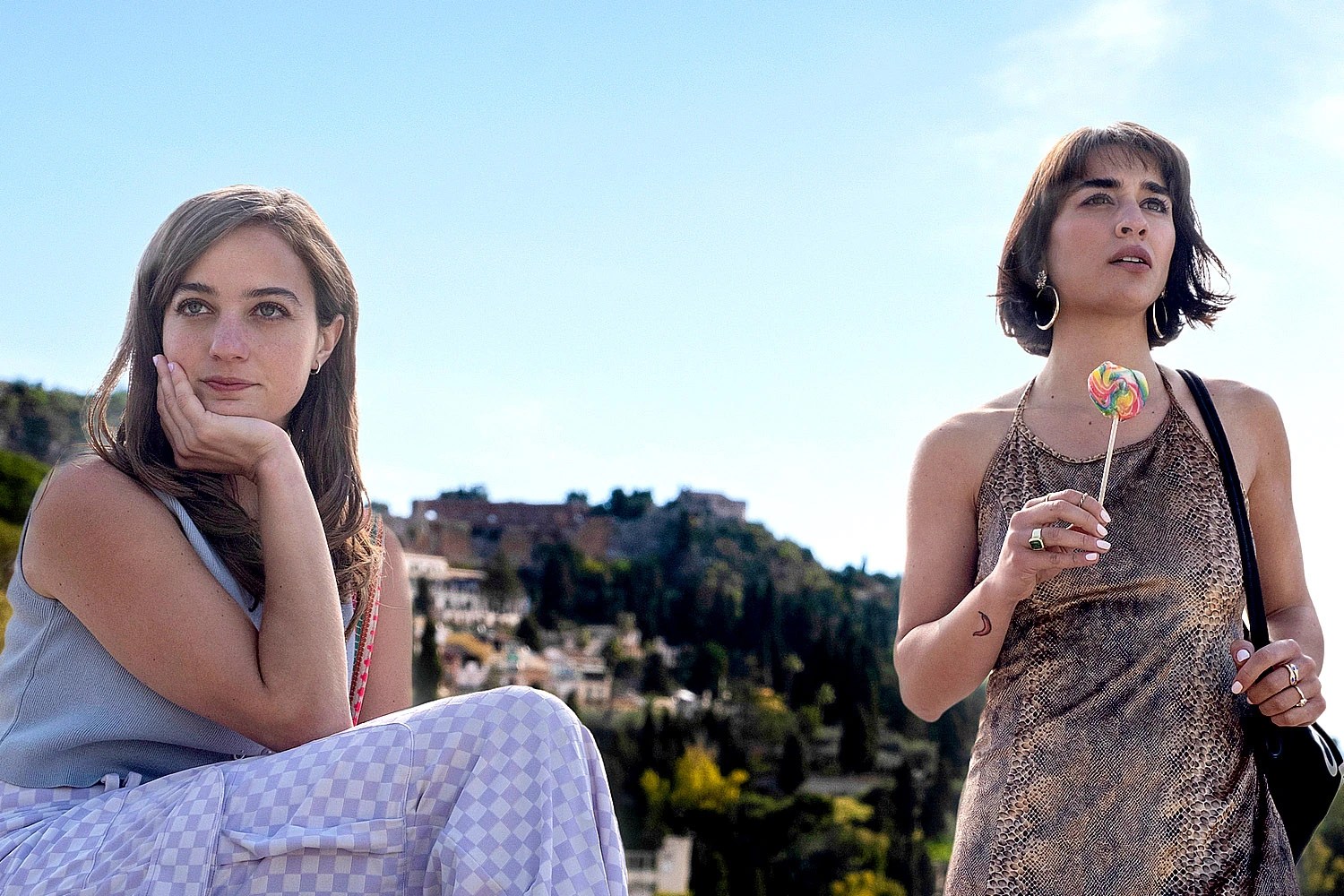
Mia and Lucia
As each Americano decides how to reconcile what Sicily has done to them, two young Italian girls Lucia (Simona Tabasco) and Mia (Beatrice Granno) sweep in to take advantage of the Americano’s dilemma. Lucia is a sex worker in the most modern sense who has her own website and a pimp (for show) who intends to spend the week with Dominic at a very high price. Lucia (unlike the rich Americano’s she is seducing) is aware of what she wants and how to get it. Knowing who you are and what you want makes you the most powerful dealer at the table. At times Lucia gets lost in the muck, but with the companionship of her friend Mia, is swooped back up into action.
For Lucia and Mia conflict and getting things done on an individual basis is a way of life. There is no concierge service attending to their every need; they are the concierge. They provide the drugs, the sex, the fun and most importantly they leave (that is if you give them their money). Tanya on the other hand cannot exist without the concierge, her every need must be communicated, heard and acted upon. When Tanya asks the front desk for “a gypsy” in an attempt to find out if her husband Greg is cheating, she gets a very accurate tarot card reader who is then blamed for being “too negative.” Tanya proceeds to then lay in bed the rest of the day asking her assistant Portia to stay close by and read “I have the new Vanity Fair.”
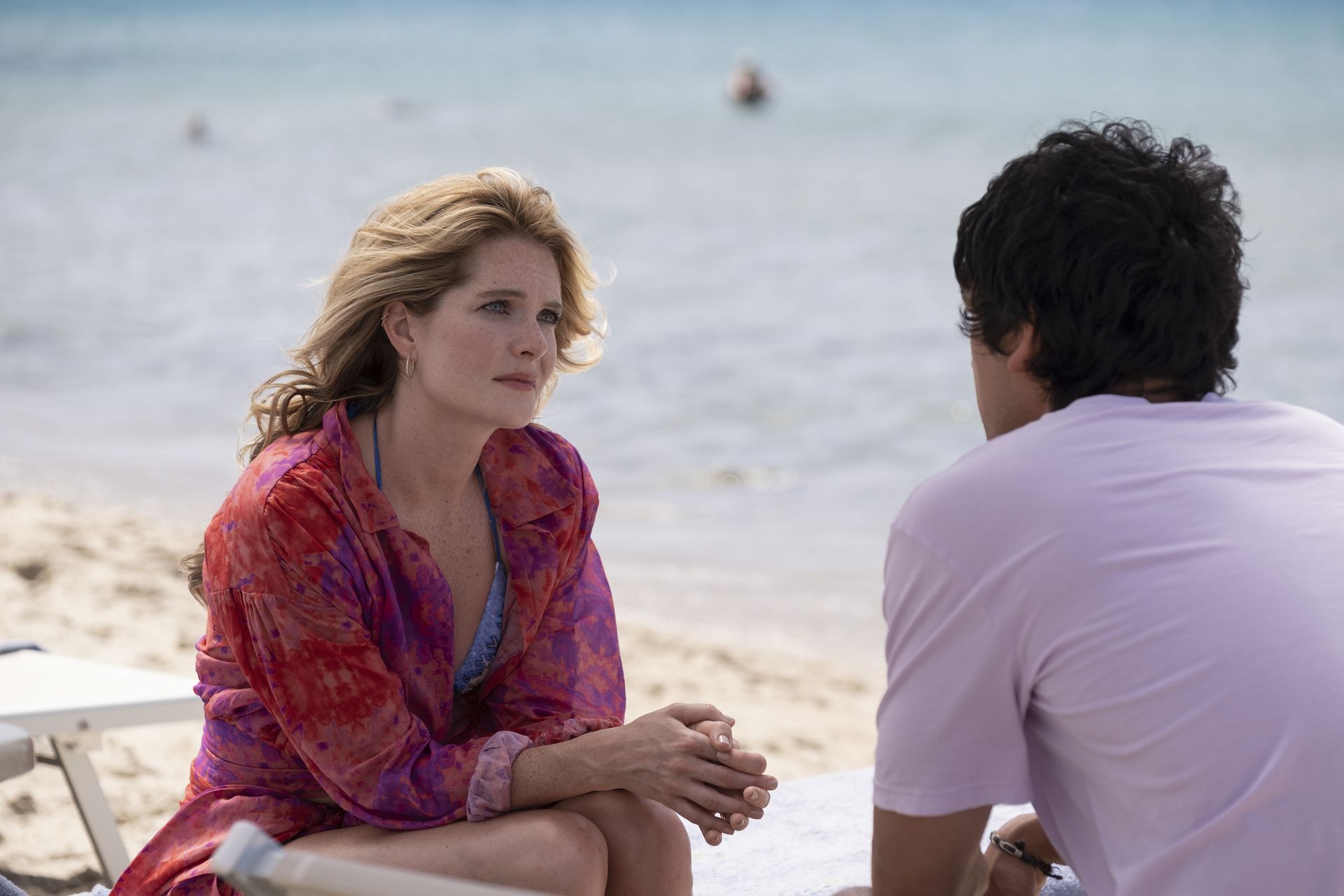
Daphne and Ethan
As the show slowly reveals its victims and villains (some of which are now dead) our living protagonists in this game of societal darwinism come out a bit smarter and wiser. They now understand the dynamics of getting what you want a bit more clearly. It doesn’t mean killing your lovers partner as Quinton (now dead) may have presumed, but maybe more along the lines of what Daphne moderates to Ethan after he informs her of Harper and Cameron’s avventura:
“I mean, we never really know what goes on in people’s minds or what they do, right? You spend every second with somebody and there’s still this part that’s a mystery. You don’t have to know everything to love someone. I am a mystery to myself, honestly I surprise myself all the time. I think you just do whatever you have to do to not to feel like a victim of life.”
One could presume that Daphne is living in a fantasy world of too much Dateline and Vanity Fair, but what she does see clearly is the impossibility of knowing everything about your partner and loving them regardless, not blindly but astutely. Daphne (like Voltaire) understands that “doubt is not a pleasant condition, but certainty is an absurd one.” One particular absurdity which propelled the show into pop culture pandemonium was Jennifer Coolidge’s performance as the absurdly un-astute Tanya who somehow manages to shoot three men dead yet can’t seem to find the stairs to safety. Inevitably White paints Tanya as a tragic figure, struggling with finding value in the simplicity of love. Like most of us when we can’t find love, we create a mess (at times an alluring mess) because what we want and who we are is out of focus. Perhaps if Tanya had accepted the love (Belinda’s spa “for poor people”) in which she was offered and denied those who were only prepared to give her beauty (Greg) she would not have ended up at the bottom of the Ionian sea.
 FILM SQUAD