
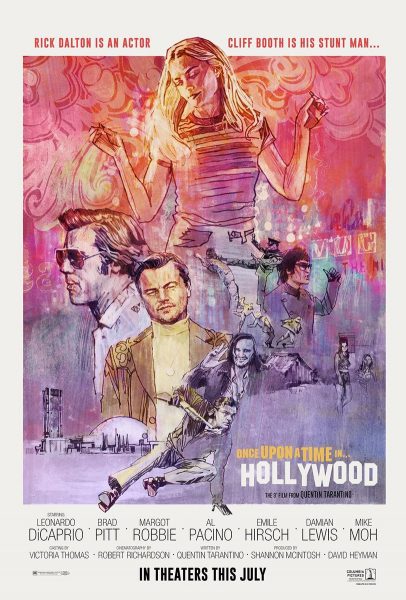
In a 2003 interview with Howard Stern Quentin Tarantino is asked by the radio host why Hollywood celebrates Roman Polanski (whom Stern refers to as a “madman”) Tarantino quickly defends Polanski stating “He didn’t rape a 13-year-old. It was statutory rape . . . I don’t believe it’s rape, not at 13, not for these 13-year-old party girls.”
Tarantino’s cavalier tendencies, whether it be towards victims of rape or cartoonish violence, is something that many of us struggle with tolerating and something that many of us get high from. As we have seen with “Django Unchained” and “Inglorious Bastards,” Tarantino has an interesting way of curating tragic violent events. With his sweeping operatic orgies of violence and sharp dialogue, it’s unclear what exactly he wants to achieve, but this is part of the fun. In Tarantino’s 9th film, “Once Upon a Time in Hollywood,” he brings us to the familiar territory of an unspeakable tragedy wrapped in a bow of satire and with a side of gore. As a viewer I went in blind on purpose (no trailer, no synopsis) having no idea that Tarantino has taken the Manson Murders and ran . . . really really far with it. Although his subject matter is stark and all encompassing, nostalgia and its two leads are the star of this picture.
We meet the endearing stuntman Cliff Booth (Brad Pitt) and his not so hot shot anymore actor/ buddy/boss Rick Dalton (Leo) through the lens of a black and white TV as the over enunciated TV reporter introduces them:
Interviewer: So, uh, Rick, explain to the audience exactly what a stunt double does.
Rick Dalton: Actors are required to do a lot of dangerous stuff. Cliff here
[Raises his cigarette to take a puff]
Rick Dalton: … is meant to help carry the load.
Interviewer: Is that, uh, how you describe your job, Cliff?
Cliff Booth: What, carrying his load?
[Looks at Rick sitting next to him]
Cliff Booth: Yeah, it’s about right.
From the very start these two fellas capture the film. They are us if we were actors: crying over unlearned lines, yelling at “dirty hippies,” (all the while holding onto a blender filled with margarita) taking shit jobs for money and contemplating moving to the valley. Rick and Cliff are bros to the fullest extent, and they are working actors. Taking Leo and Pitt down a notch is one of the best things Tarantino has ever done. Cliff lives across the fence from the The Van Nuys Drive-In Theatre in an old airstream trailer. He is content with the simple greeting from his pitbull Brandy (the ease of living with a dog as opposed to human’s suits Cliff) and in true bachelor style Cliff fixes himself up a box of Kraft mac & cheese, eating from the pan with a wooden spoon as he watches “Mannix.” Cliff is strangely the moral center of this film, be it the somewhat reckless moral center.
After one of the Manson “family” members, Pussycat (Margaret Qualley), asks Cliff for a ride and a blow job, Cliff asks to see ID as he ain’t lookin to go to jail for no “poontang.” Once at the infamous Spahn Movie Ranch, Cliff checks in on the Ranch’s owner George Spahn (Bruce Dern) to ensure he is not being taken advantage of, which HE IS. While Leo’s Rick Dalton lacks some of the sense of his compadre, it’s refreshing to see Leo play an actor with low self-esteem who drinks too much and doesn’t drive a Tesla. Rick’s pad is covered with western attire dressed up in his name sake, evoking a sense of a time gone by, a time that has no intention of taking Rick with it.
These two knuckleheads save us from any potential offense we may feel regarding the Tate murders, but not entirely. Let’s talk about that for a moment. The ego that is required for re-telling one of the most gruesome acts in Hollywood history, is beyond comprehension. Not only has Tarantino saved the Jews from Hitler in “Inglorious Bastards” but he also saved Sharon Tate and Roman Polanski’s victim (as it is safe to assume Polanski would not have raped a 13-year-old girl eight years after the murders had his wife and child lived). The same victim Tarantino referred to as a “party girl” in the Stern interview. But this is of course why we dig him; his irreverence and ego make all of this possible.
Tarantino has since (in a very heartfelt manner) apologized to Polanski’s victim and regarding Uma Thurman’s crash in “Kill Bill,” he told Deadline that it was “the biggest regret of my life.” Tarantino has since given Thurman the footage of her crash in “Kill Bill.” And Thurman’s daughter (Maya Hawke) who plays “Flower Child” in “Once Upon a Time,” speeds down the Hollywood Hills in an old taxicab! There is no doubt Tarantino likes to play with fire. “Jezebel” and the #metoo movement are ready to hold him accountable if he goes too far. A great movie scene is priceless, but at what cost?
The nostalgia in the film also allows us to welcome in the satire/murder scenario. Los Angeles in the late 60’s is painted like a whimsical dream with the music of Paul Revere and the Raiders intentionally sprinkled throughout the film (approximately two years before the murders Manson had tried to get a record deal from PRR’s Producer Terry Melcher). Tarantino perfects every detail right down to Red Apple cigarettes, neon lights, wooden interiors and Cliff’s 1960 Karmann Ghia.
Regardless of how we feel about Tarantino and the way he treats his actors and subject matters, this is one of his most brilliant films, however I often wonder what would happen if Tarantino put ego aside? Nuance and random are fun, but what if Tarantino had a “Boogie Nights” or “Chinatown” in his repertoire? Where he didn’t have to rely on re-writing history? Tarantino’s ensemble cast in “Once Upon a Time” can be overwhelming (we could have done without Rumor Willis and Damian Lewis as a badly wigged Steve McQueen) but our two main hot shots carry us through the plot splendidly.
Despite Tarantino’s best efforts to whirl us into a comedy, the final scene is devastating as a curious Jay Sebring (Emile Hirsch) asks what all the commotion was about. This scene is the purest of fiction as Sebring was one of the victims of the Manson Murders. A famous hairdresser and the former fiancée of Sharon Tate, according to Dominick Dunne’s Vanity Fair article “Murder Most Unforgettable,” Sebring tried to persuade the “family” to consider Tate’s pregnancy, so they shot him and then stabbed him 7 times. Another victim, Voytek Frykowski, would be stabbed 51 times and Tate (who would be stabbed 16 times) was found by detectives dead, listless and hanging from a wooden beam in the living room of her home.
 FILM SQUAD